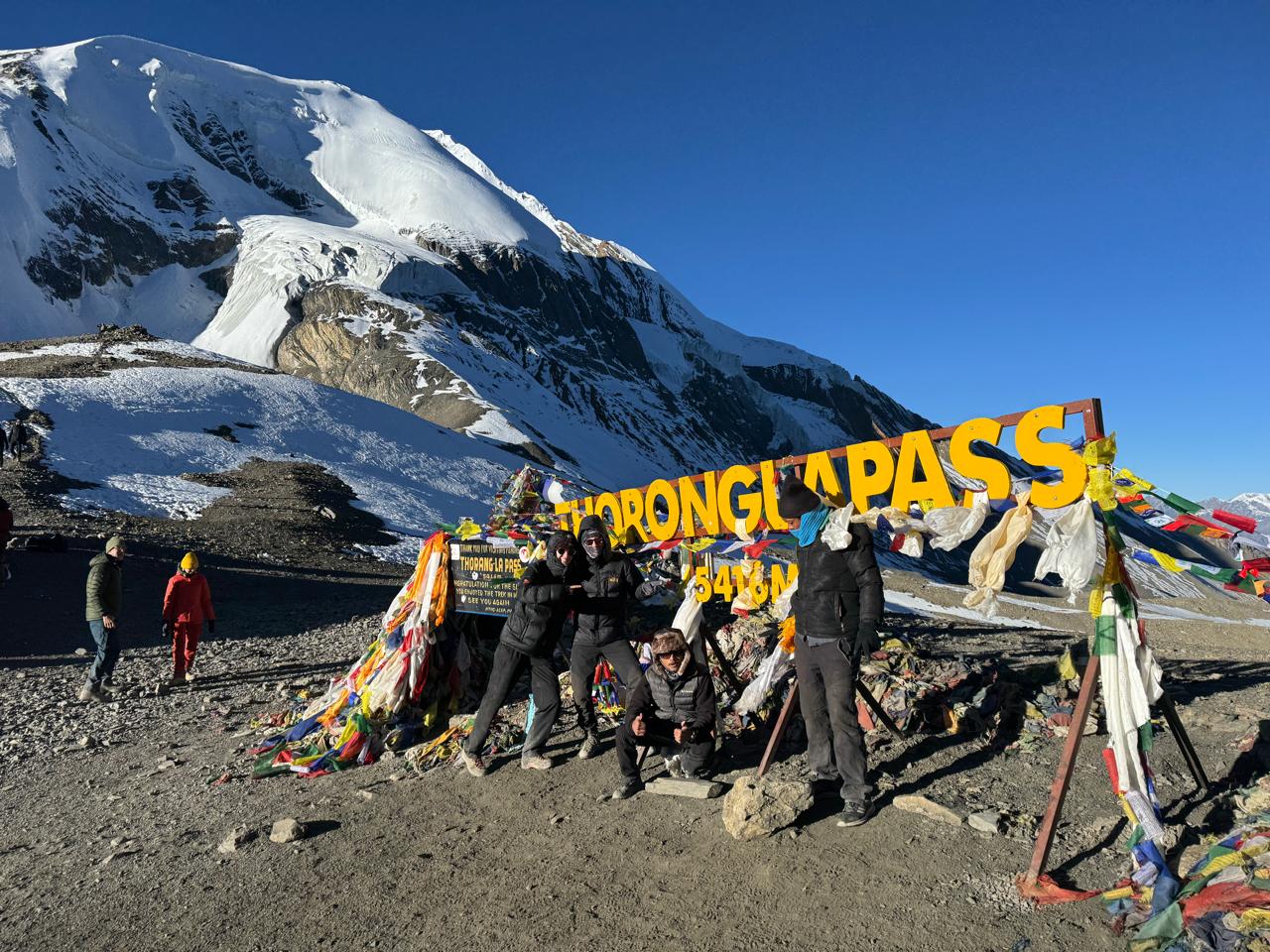
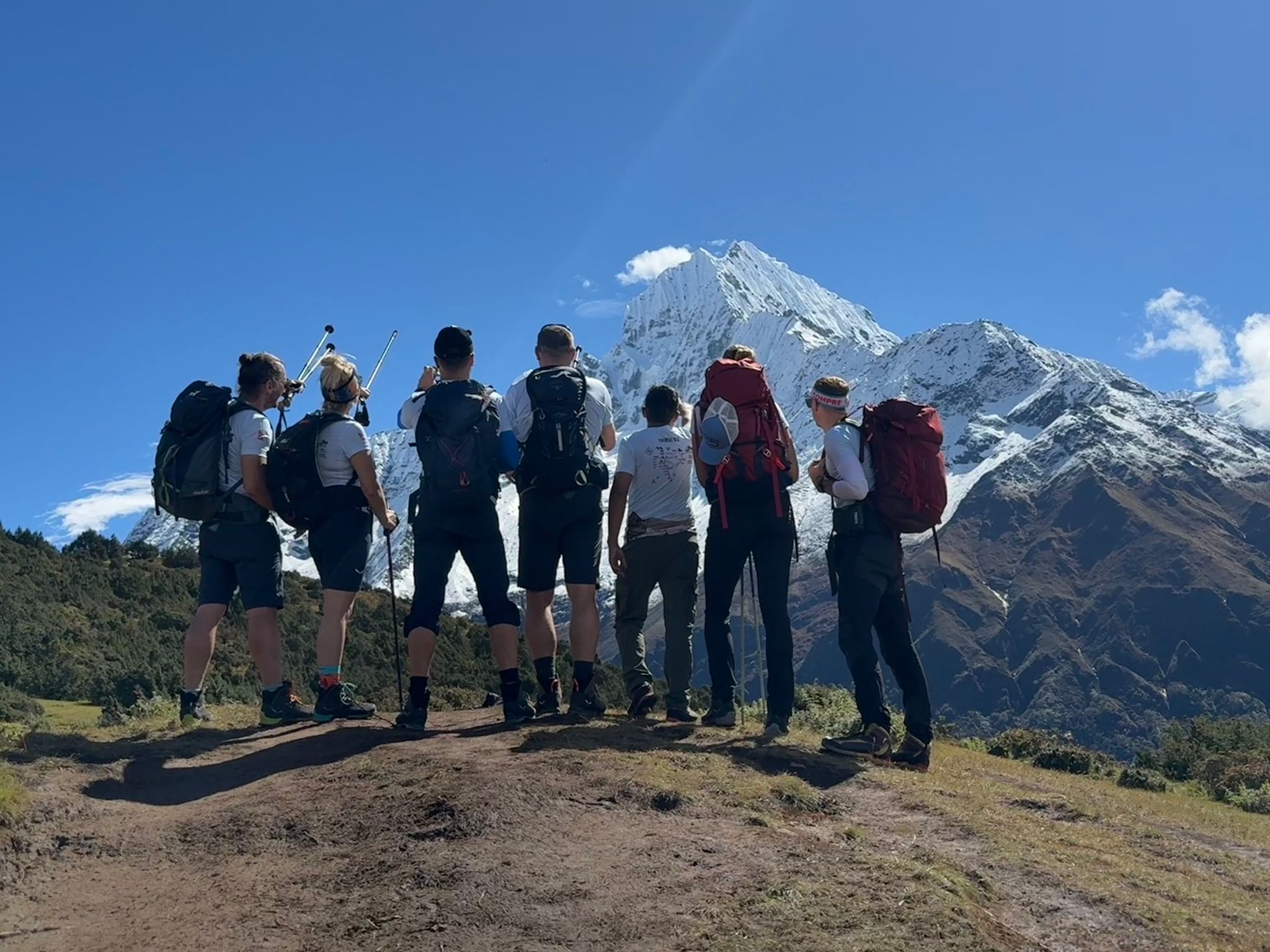
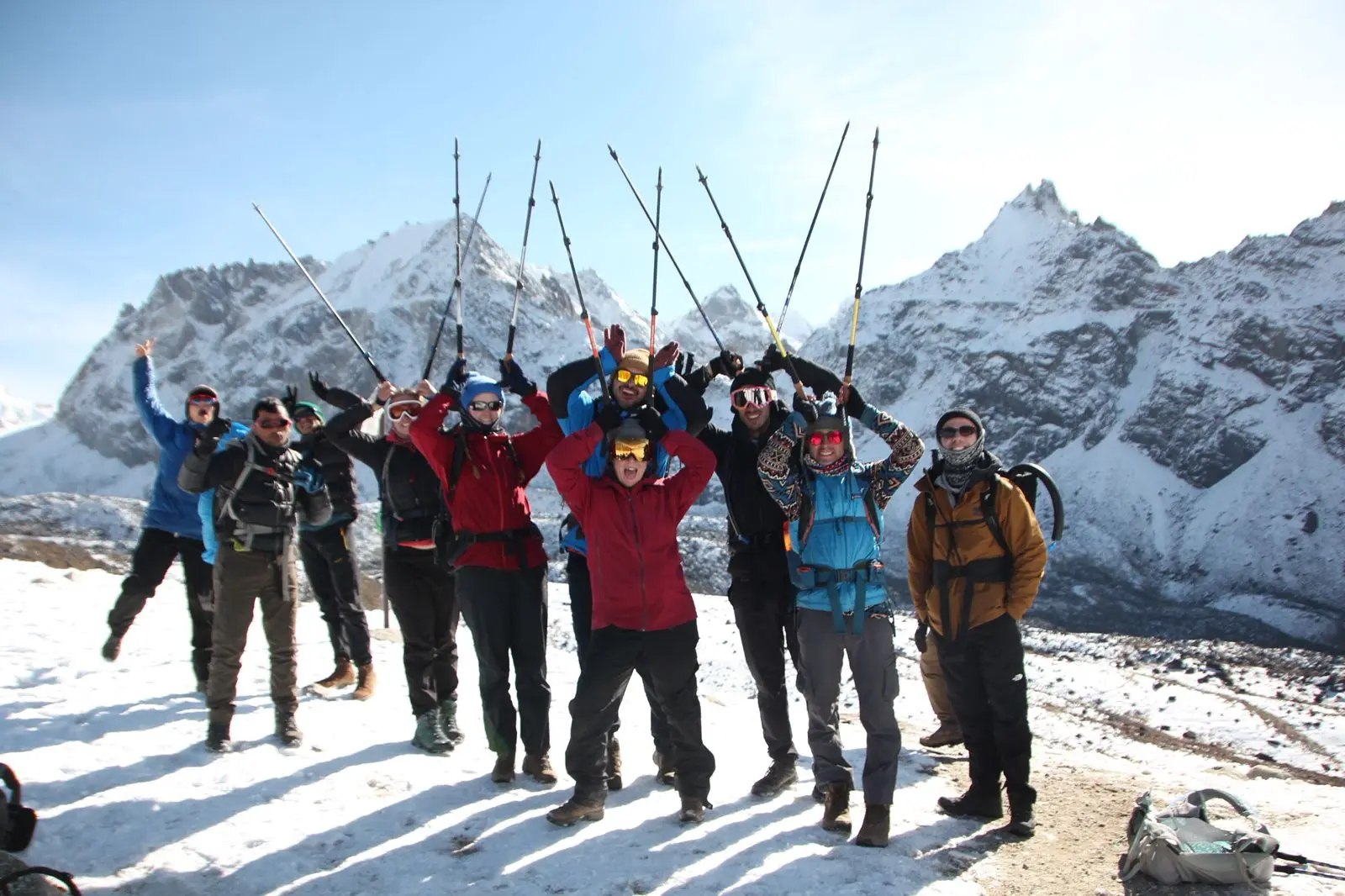
After crossing the Thorong La Pass at 5416m, our hike continues on the other side of the mountain. We descend directly 1700 meters in altitude to Muktinath, where we continue the next day.
Trek Day 9: Muktinath to Tatopani
20km drive, from 3710m to 1200m
Unfortunately, Pati gets a fever again during the night. Probably the exhaustion. At seven in the morning I go to the famous temple complex of Muktinath together with Rabin and Krali. Buddhist and Hindu pilgrims from all over the world travel to this place to pray in the special temple. So with sore muscles from the day before, we go up hundreds of steps to the entrance. Professionally, Krali estimates that there must be 😆 about 40 steps – that’s only almost right.
On the way up, we pass ancient traditional Nepalese earth houses, which are built right next to the steps down into the ground, like a cave. In fact, people still live there and we can even watch a woman cooking on stones and with wood.
We also pass a rest area. When I ask what the huge rest area with at least 20 benches is for, Rabin explains that many people who hike up here get altitude sickness. After all, we are still at an altitude of almost 4000 m. Soon, a clinic is even to be built here at the rest area. Practical to achieve if you “only” have to 😆 overcome several hundred steps. Further up at the temple complex we see another sign that explains the risks of altitude sickness. Somehow absurd.
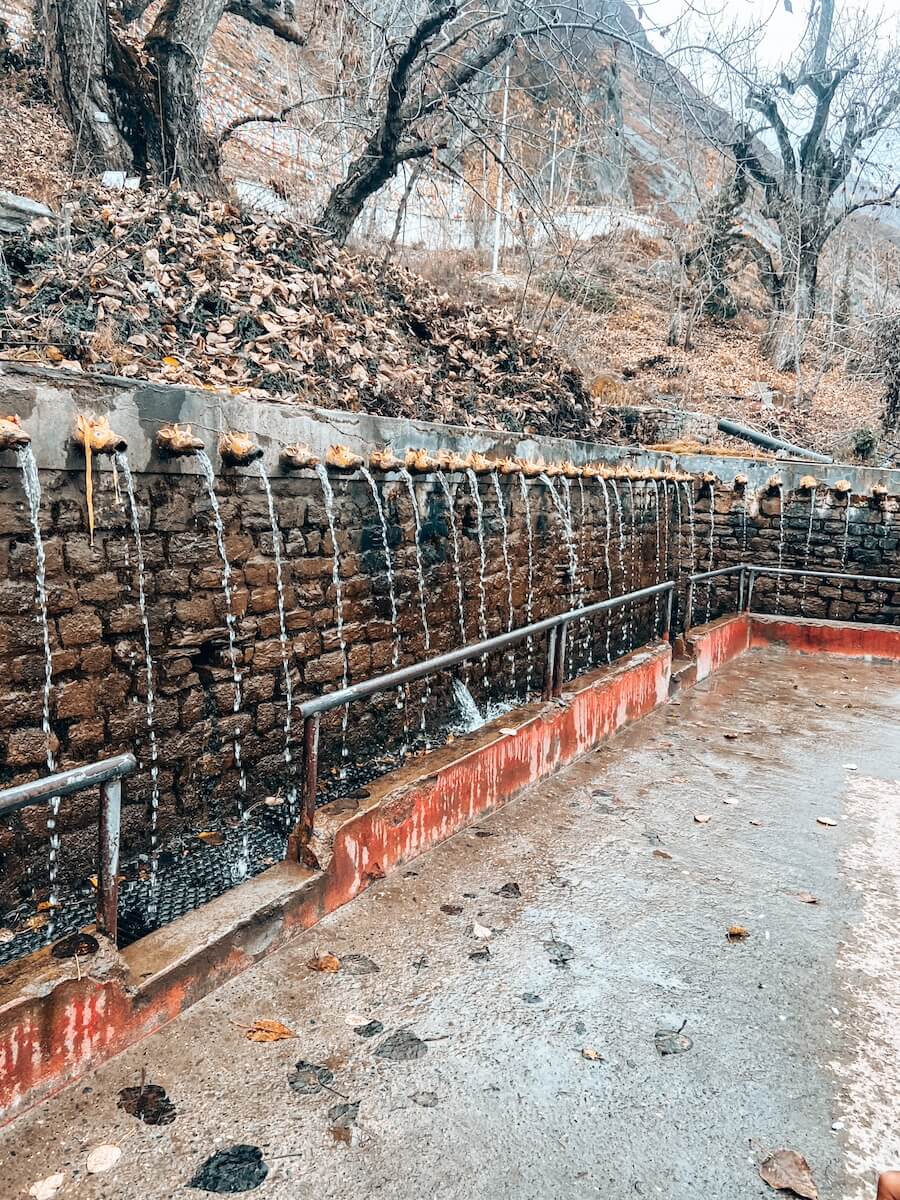
Rabin tells all kinds of things about the temple complex and its history. He himself belongs to Hinduism and knows a lot about it. The Hindu temple is the only temple in Nepal with 108 water fountains and two huge, ice-cold pools that serve to purify the soul. That’s why many people come here and walk through all 108 fountains on the wall in their clothes and then touch the bottom of the deep pools. In this way, the believers believe that they are freed from all sins. Just watching is spectacular – after all, it’s no more than 8 degrees outside.
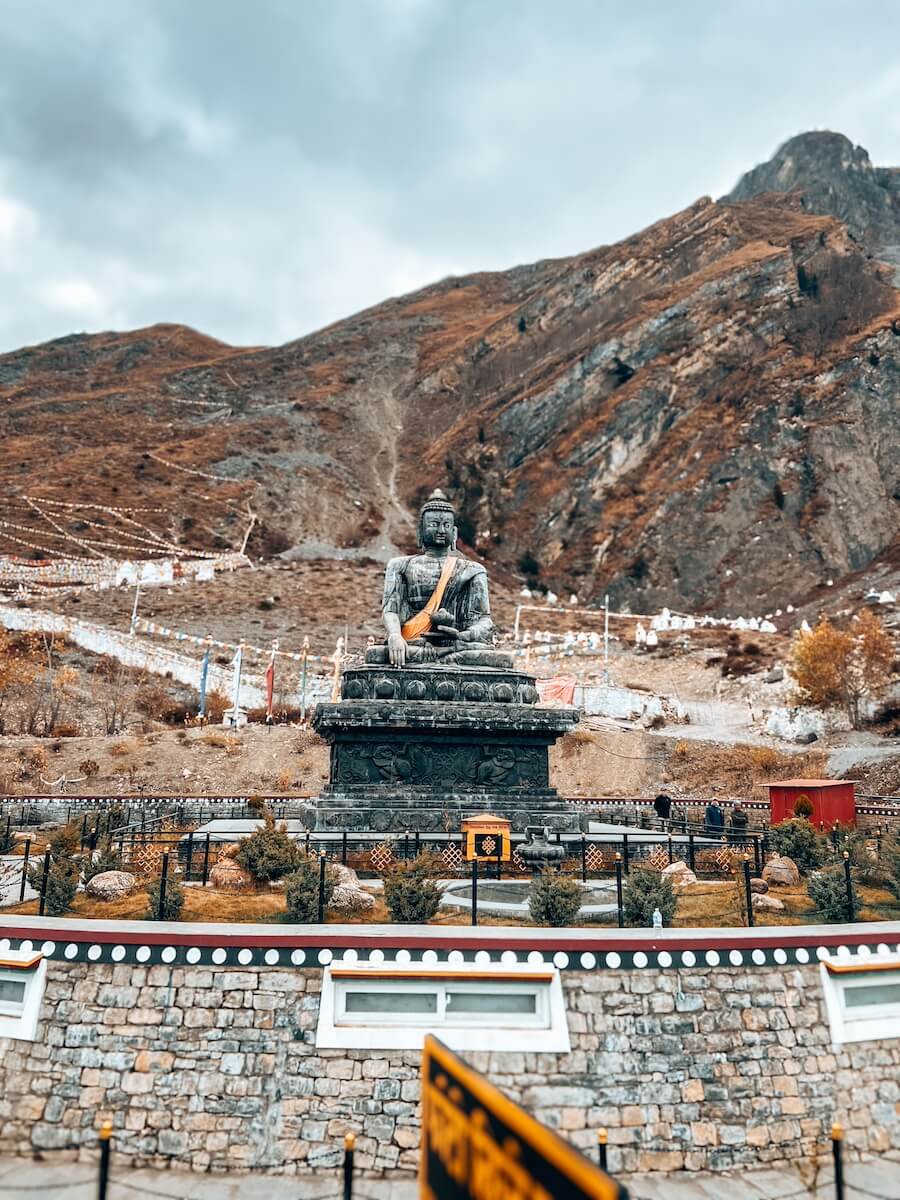
After the Hindu temple we look at the Buddhist part of the complex, now it’s Krali’s turn with his stories and explanations – he is a Buddhist. Apparently, there are only 14 of the huge Buddha statue like here in Muktinath in the whole world. I don’t quite understand why and unfortunately Krali can’t explain it that exactly. When I google later, the Internet explains the following to me:
“The Buddha statue in Muktinath, which is considered particularly famous in the region, is not unique in the sense that it exists only 14 times in the world. However, there seems to be a special legend or myth that says that there are only 14 specific Buddha statues in the world that have a special meaning or spiritual status. This number could be symbolic or refer to a particular group of statues that meet certain historical or religious criteria.”
So what exactly is behind it remains a little secret. In any case, many people make a pilgrimage here because of the statue. As with the Buddhist stupas, we walk three laps clockwise around the Buddha while Krali chants a mantra. Then we look at the rest of the temple complex and I hear some more exciting stories before we go back to the hotel to Pati and have breakfast. We were on our way to the temple very early and sober, because it is considered unclean if you have already eaten something before.
I thank Krali and Rabin for taking me along and explaining so much to me. On the way back, Rabin gives me a bracelet with stones from Muktinath, which, according to Krali, bring special luck – a unique gift.
By the way, today we have not had excellent weather for the first time. It is cloudy. So far we have had sunshine and bright blue skies every day. The conditions were perfect to conquer the Thorong La Pass.
For breakfast we have masala tea and Tibetan bread (similar to our Kiachl) with curry. It tastes fantastic! Then a jeep is already waiting for us in front of the front door. The next 20km we only descend through riverbeds into the valley. The paths were washed away during the heavy rainfall a few weeks ago, so we are allowed to drive this part (mostly) off-road instead of walking. We share the jeep with a French couple and their guide and porter. There are nine of us in a jeep for seven people. So it’s going to be cuddly again.
Let’s go to Tatopani. The road is really only partly a road and the ride is bumpy again. Many bridges are simply no longer there. When we have to go over one, we see how our driver quickly worships the little Buddha on his dashboard. Fortunately, everything goes well.
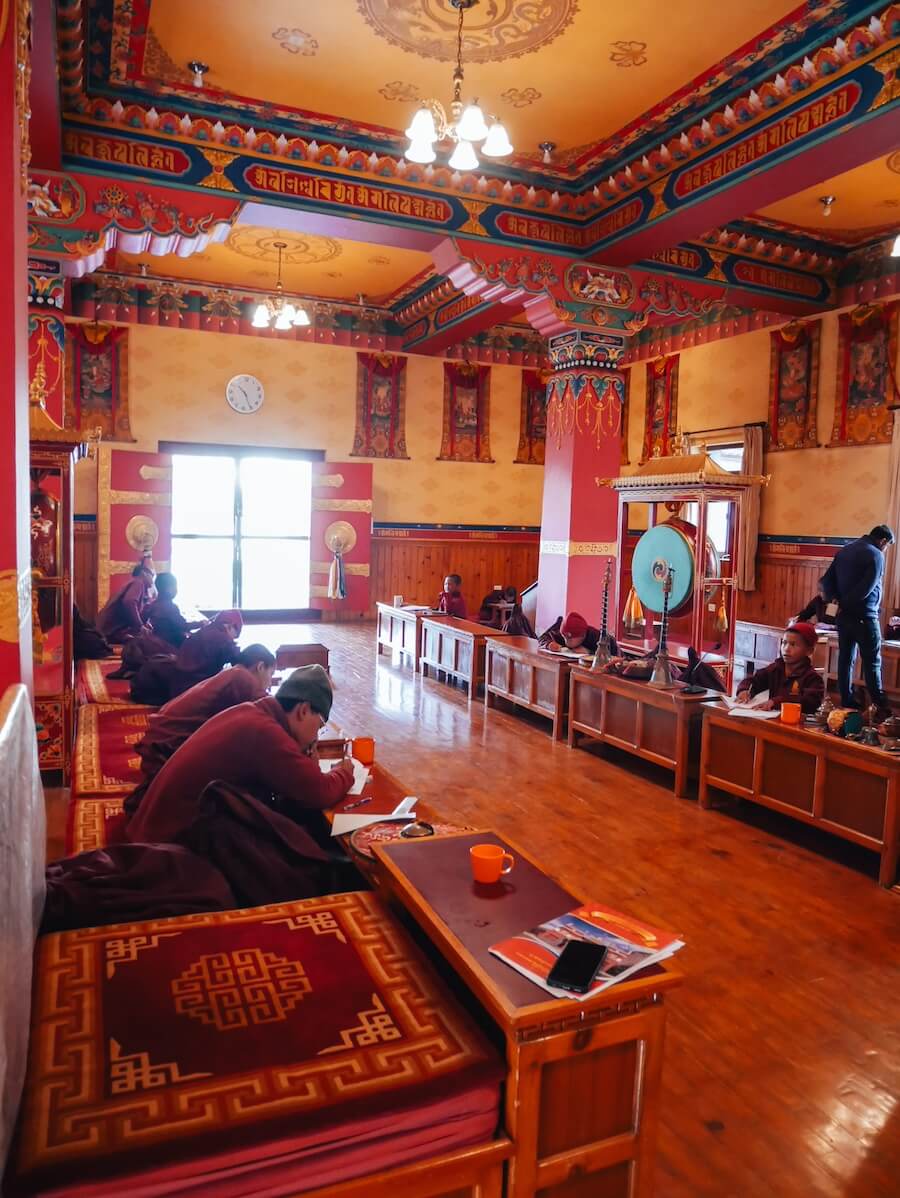
After about an hour we stop him Jomsom. There is a Buddhist monastery to see there. At first it seems as if the monastery is closed, but the policeman on site asks our guide to simply open the door. Shortly afterwards we are standing in the monastery garden. The door to the actual monastery also seems to be locked, but our guide can no longer be stopped. He shakes the door, which is opened immediately afterwards. Then we’re already in. The main part of the monastery consists of only a single room with three huge Buddha statues at the very front. The reason why all the doors seemed to be locked is quickly obvious: the young monks who are being taught here are currently writing an exam. But we are in Nepal, so no problem. One of the examinees (the one who speaks English best) even has to stand up and give us a short tour of the monastery room. Again, it’s all kind of absurd – but nice. After a 20-minute visit, we leave the monastery again and our bumpy ride continues.
During the journey, the porter of the French group, who is in the passenger seat, falls asleep. The guide of the other group, who is sitting at the very back of the car, sees this and asks the French woman in the middle row to fasten his seatbelt. Apparently, you can drive awake without a seatbelt, but sleeping it is too dangerous😅 even for Nepal.
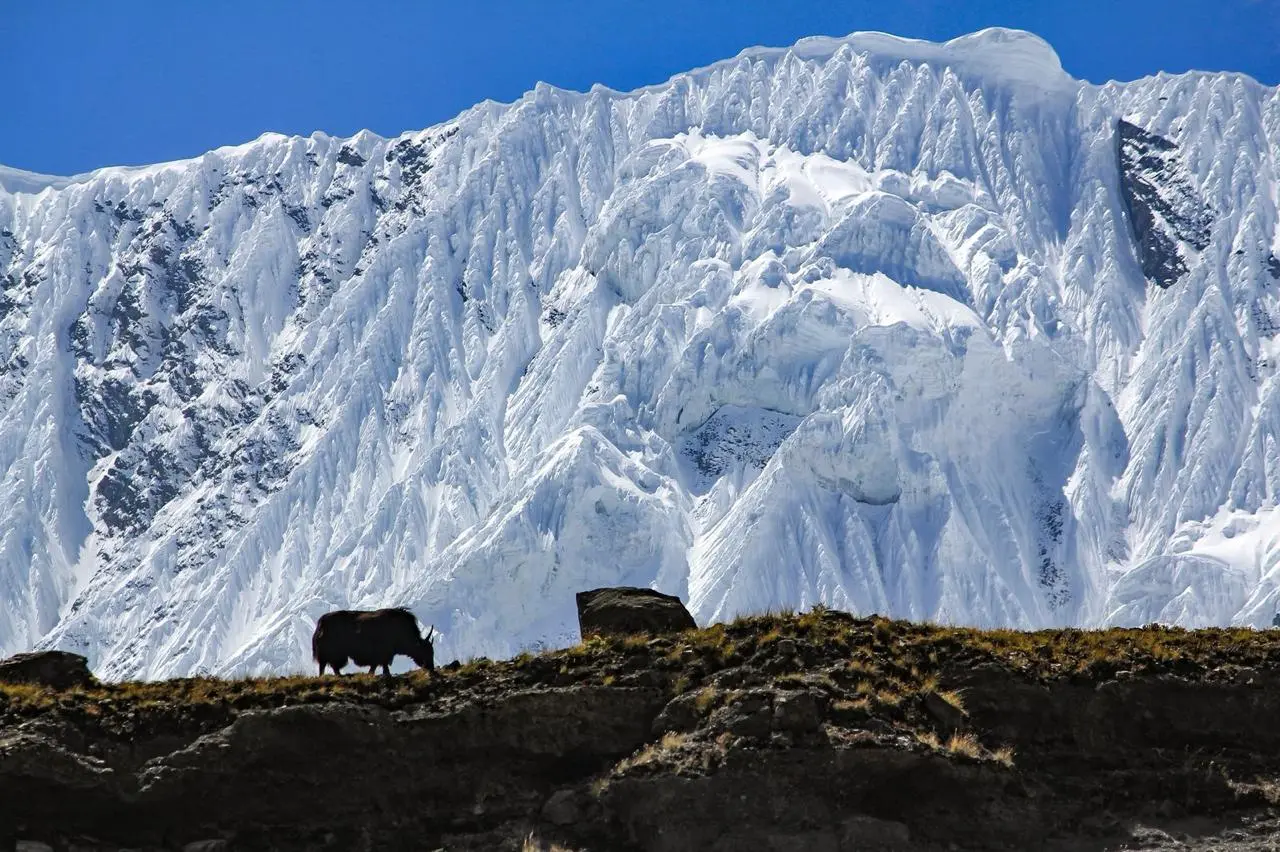
At a waterfall we take another break. Rabin comes up to us and offers us a piece of “hard something”: yak cheese, as it turns out. More precisely, probably the bark of it. This is chewed like chewing gum, except that it is much harder than chewing gum and really doesn’t taste that good. But definitely a good pastime.
For the 20km to Tatopani we need a little more than three hours. Then we have a Dal Bhat for lunch in Tatopani. Tatopani is known for its hot springs, which we check out in the afternoon. The hot springs are indeed really hot. After 5 minutes we almost can’t stand it anymore and after 10 minutes we have to get out of the water again. Krali, who came with us but of course didn’t go into the water, is surprised that we are out again so quickly. He claims to have been water for about 1 hour last time (but according to his estimation it was only 40 steps up to the temple, so who knows 😄).
Trek Day 10: Tatopani to Ghorepani
17km, 6 hours, from 1200m to 2850m
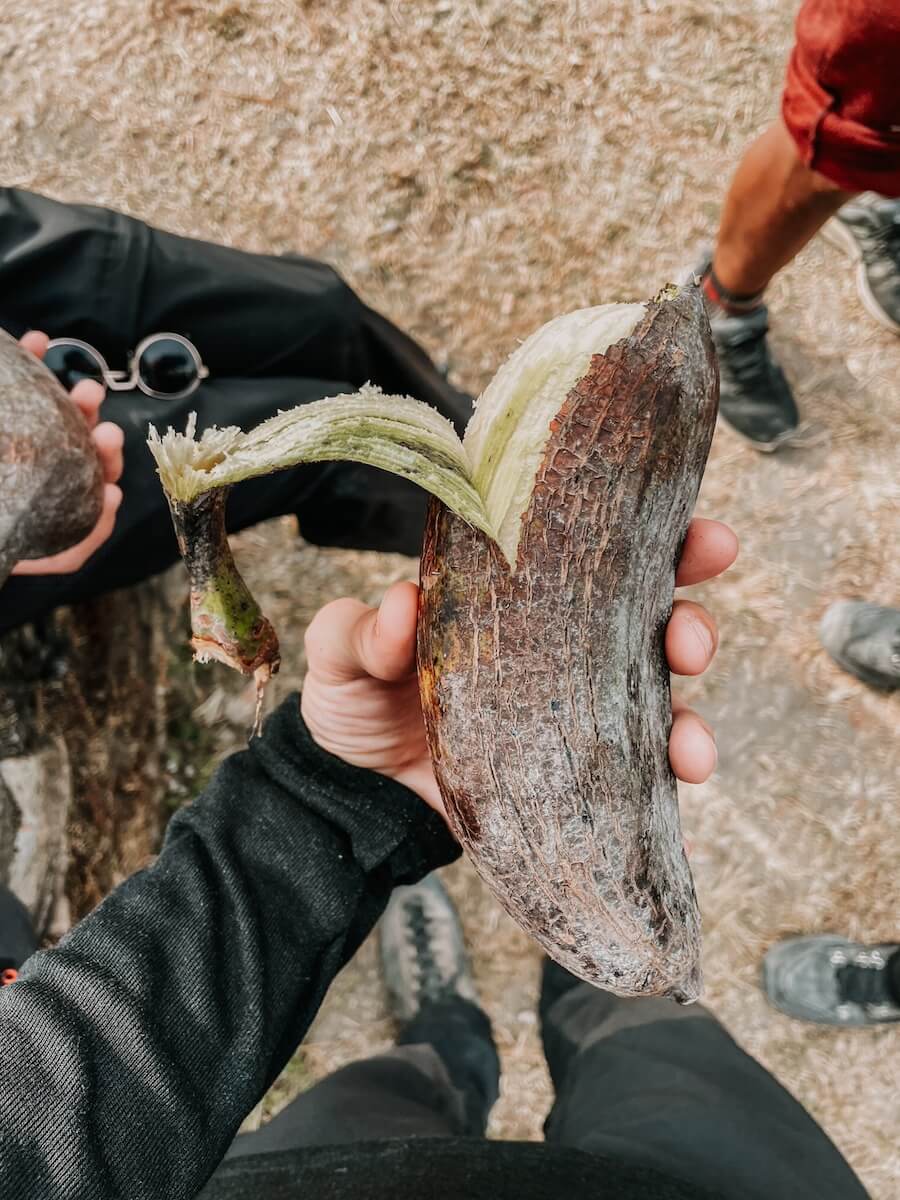
The next day we have a long hike ahead of us. 1600 meters in altitude and 17 km from us is the next village, Ghorepani. The first half of the day we are really lucky with the weather. We pass countless rice plantations, walk through local villages in the mountains and take a tea break in the sun. Rabin buys a kind of banana on the way that we have never seen before. It weighs at least one kilo and is incredibly huge. Fortunately, it is not yet ripe in the middle, so at least we don’t have to eat it completely. Guava, lemons and oranges also grow along the way. It’s really tropical here.
For lunch we have Dal Bhat in a tea house on the way. As always, we wait quite a long time for our food. This time, however, we can watch the weather get worse by the minute. Even before the food is on the table, it rains.
While eating, Krali hits the window next to him and catches his target: a fly. When she still moves, he hits it with the flat of his hand, takes it and carries it out – of course while he is singing a mantra… these Buddhists.
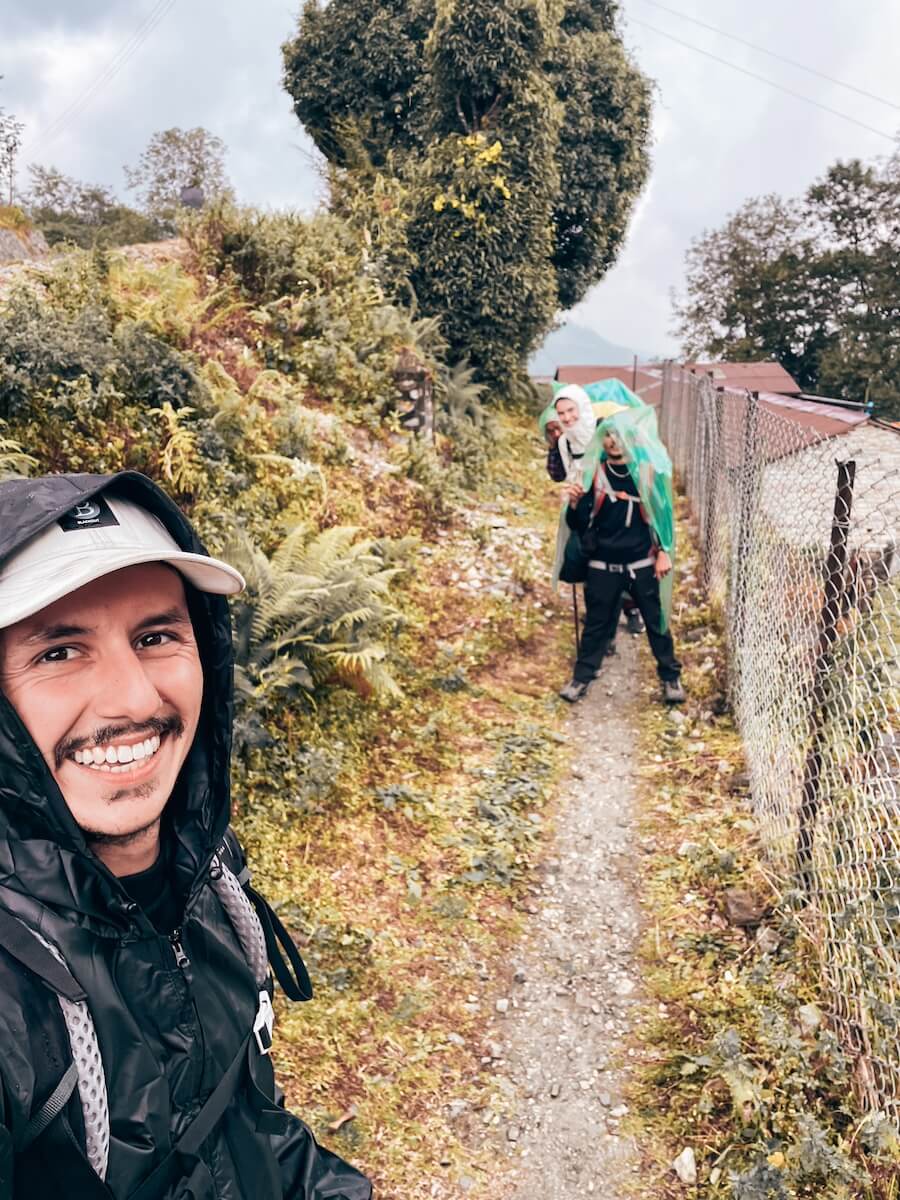
After the meal it rains even more. We unpack our rain jackets and pull the rain cover over our backpacks. Then we march off in the rain. When it rains here in Asia, you can’t imagine it the same way as at home: a few drops, a few more, half an hour a lot of water falls from the sky, but then the thing comes back and it drips away for a while at most. Real rainy days are rather rare.
Here, however, it rains first, and then it pours. And tomorrow it may stop again. We stop again not too far from our lunch stop and Rabin and Krali get a garbage bag there, which they pull over their equipment. They still ask us if we want one too. We say no (but should have known better).
800 meters of altitude still lie ahead of us and we are already soaking wet. We are really fast, but the mood in the group is slowly sinking into the basement. When we are still about half an hour away from our destination – we are already back at over 2600m, wet from head to toe and everyone is freezing cold – it starts to hail. We are somewhere in the middle of nowhere and can’t let it get us down. We hike as fast as we can further up. The last 15 minutes we can also hear a thunderstorm from afar. But before it gets closer, we finally reach our accommodation for the evening.
Fortunately, the stove in the dining hall is already heated and we can spread out all our equipment in front of it. Then there is a gas-powered hot shower and all the wet contents from the backpack (the rain cover could no longer keep everything out) are spread out on the room floor.
The thunderstorm is getting closer and closer. Suddenly we hear a loud crash. In the next second, the power fails. So that’s it for the electricity until tomorrow. Luckily, there are a few battery-operated lights in the teahouse and one of our cell phones can also act as a flashlight.
After dinner we are quite exhausted and want to go to bed. However, our things that are in front of the stove are not yet dry. I ask Rabin if we can let the things dry here overnight. Rabin’s answer is, as with the tax question: “Jenny, this is Nepal”. So for us, this means that we pack all the clothes that are still damp and spread them out in our small room overnight.
In addition to some words of the national language, we learn Rabin’s very own language for time and route indications
It’s close. – 30 minutes.
Not far. – 1 hour.
Not so far. – 2 hours.
Not too far. – 3 hours.
Just a little. – 3 hours.
Little far. – 5 hours.
A bit far. – 8 hours.
It depends… – He really has no idea.
Trek Day 11: Ghorepani to Tadapani
14km, 3 hours, from 2850m to 2610m
The very next morning, when the alarm clock rings, we bring the things, which of course have not dried in the ice-cold night at 2850m, back down in front of the stove. Today we go to Tadapani. The weather is much better than yesterday and only a little further up on the higher mountains we can see snow. Immediately after breakfast it starts. We use the morning and reach our next destination on time when the first raindrops patter down again. We spend the afternoon in the hut warming up, drying, reading, playing and drinking beer.
Trek Day 12: Tadapani to Ghandruk
7km, 2 hours, from 2610m to 1940m
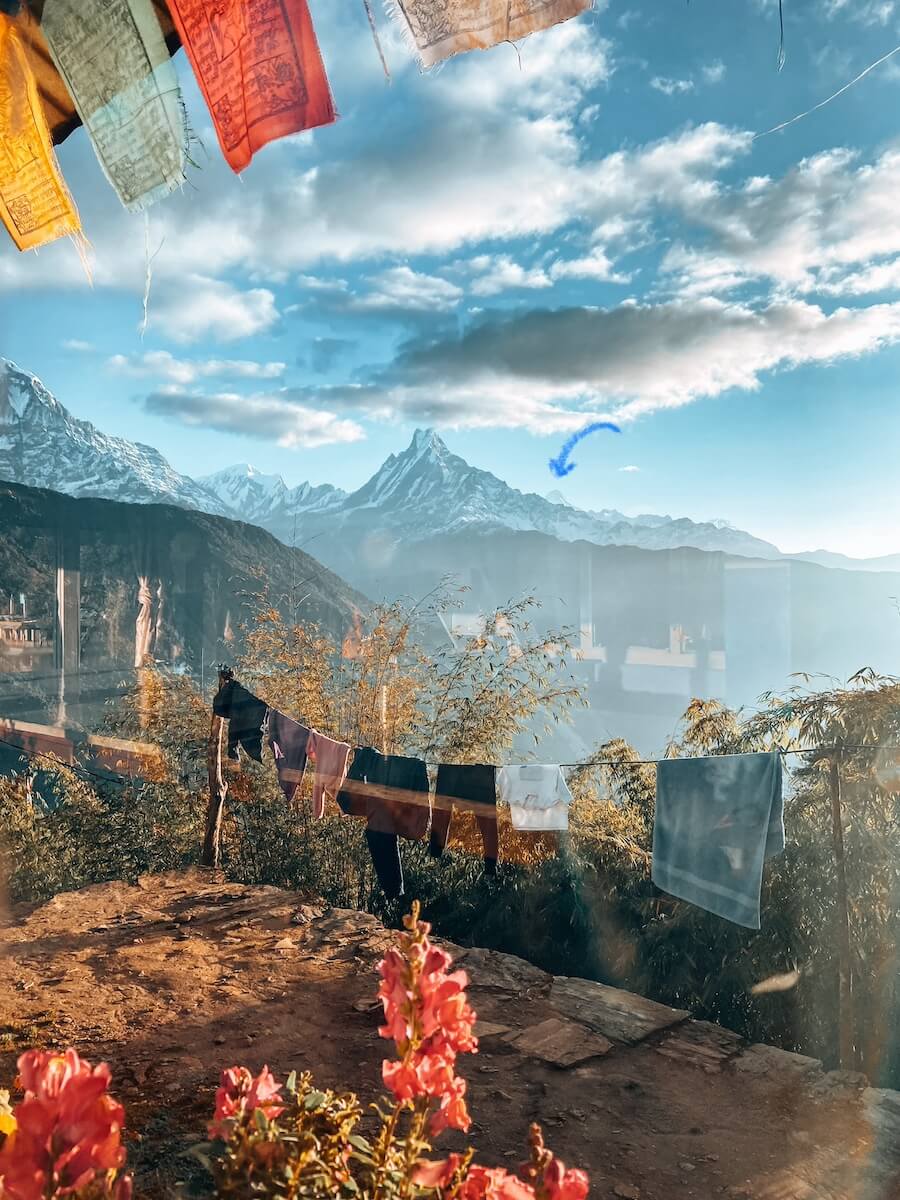
The last hiking day of the trek has begun. The weather is good again this morning and so we leave early. This morning, still in Tadapani, we even catch a glimpse of Annapurna I (8091m) for the first and only time right at breakfast.
View of Annapurna I (8091m).
Instead of the usual 12-17 km of the last few days, the way today is much shorter and only 7 km long. So we are already in Ghandruk before lunch. Here we spend the rest of the day with good food and sunny weather. Of course, a deck of cards is not to be missed. After dinner, there is rum Nepali style (with hot water and honey) for everyone to celebrate the day. The mood is exuberant. We play, dance, laugh and talk about all kinds of things. We are a little bit sad that the trek is already over. Time has passed incredibly fast.
Trek Day 13: Ghandruk to Pokhara
28km drive, from 1940m to 822m
At 6:15 a.m. the last day of our trek starts. Today we just have to have breakfast and then walk to the jeep parking lot. Our driver is already waiting there. Once again, we are in for a bumpy ride. It takes about three hours until we arrive in Pokhara. Our Porter Krali leaves us there. He is already taking the bus back to Kathmandu today. Rabin, on the other hand, stays with us in Pokhara for another day.
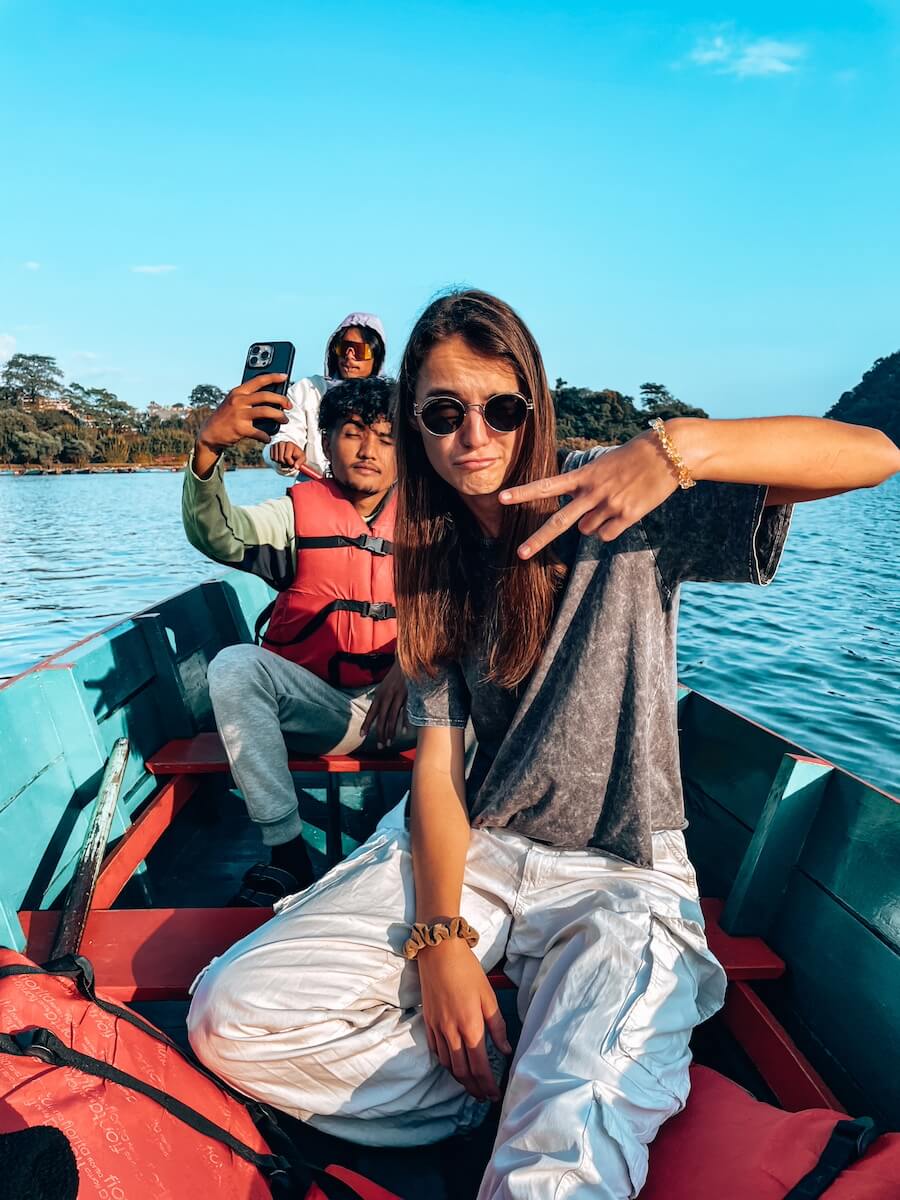
Together we explore the city, which is located on a large lake. The lake is considered the Nepalese sea, so to speak. Many people come here for holidays because of the lake. Accordingly, many people are there and rent boats (you don’t swim in Nepal, as elsewhere in Asia). Rabin persuades us to borrow a small nutshell. We think that we will paddle across the lake with the boat ourselves, but Rabin even rents a driver for a whole hour for 100 rupees (about 60 cents). So we are paddled across the lake.
Rabin tells us beforehand that he can stay afloat in a swimming pool, but he can’t really swim. He therefore prefers to put on a life jacket, which we find reasonable, but also very funny. When we get in, Rabin sends us both ahead with the words: “I don’t know how to swim if it sinks”. Quite nervous at first, Rabin holds on to both sides of the boat.
Of course, he is always up for a cool pose. We walk around a temple that is located in the lake and are on the water for about an hour. Afterwards there is masala tea for all of us. In the evening we meet Rabin again for a beer and let the – this time really – last day together come to a leisurely end. Early the next morning Rabin drives back to Kathmandu, we stay another day in Pokhara.
Pokhara
The next day in Pokhara we do what we do best: we walk from one café to another and have a good time. In the late afternoon, Denis joins us, who is now feeling better again. We meet him for dinner and have a lot to tell about the trek. The next morning we go back to Kathmandu and Denis stays in Pokhara for two more days. But we meet him again in Kathmandu.
The bus ride from Pokhara to Kathmandu is anything but pleasant. You could also call the trip the worst bus ride ever. The bus, which is even called a tourist bus, is very comfortable inside and has couch-like seats, but unfortunately that doesn’t help if the roads are not available. 11 (!!) For hours we are thrown out of our seats and pushed back in; Everything hurts. Maybe it would be better to have regular bus seats instead of this ultra-soft couch. In 11 hours we cover only 200km – amazing.
When we finally arrive in Kathmandu after a long 11 hours, we are very happy and really exhausted. This bus ride was certainly the most strenuous part of the entire trek. We check into our hostel, return our borrowed sleeping bags and down jackets, eat something else and then fall into bed. The next morning we have sore muscles all over our bodies. Life here is really crazy.
Back in Kathmandu
Our last five days in Nepal we stay in Kathmandu. We don’t want to go anywhere by bus anymore and Kathmandu is really beautiful. Denis also comes back and we are even invited home by Arjun and Rabin for dinner.
Arjun calls in the morning to tell us that Rabin will pick us up – after all, we don’t know where Arjun’s house is. At 3.30 p.m. the time has come. Rabin does not have a driver’s license and therefore comes by taxi. Together with us, he then takes a taxi back to his home.
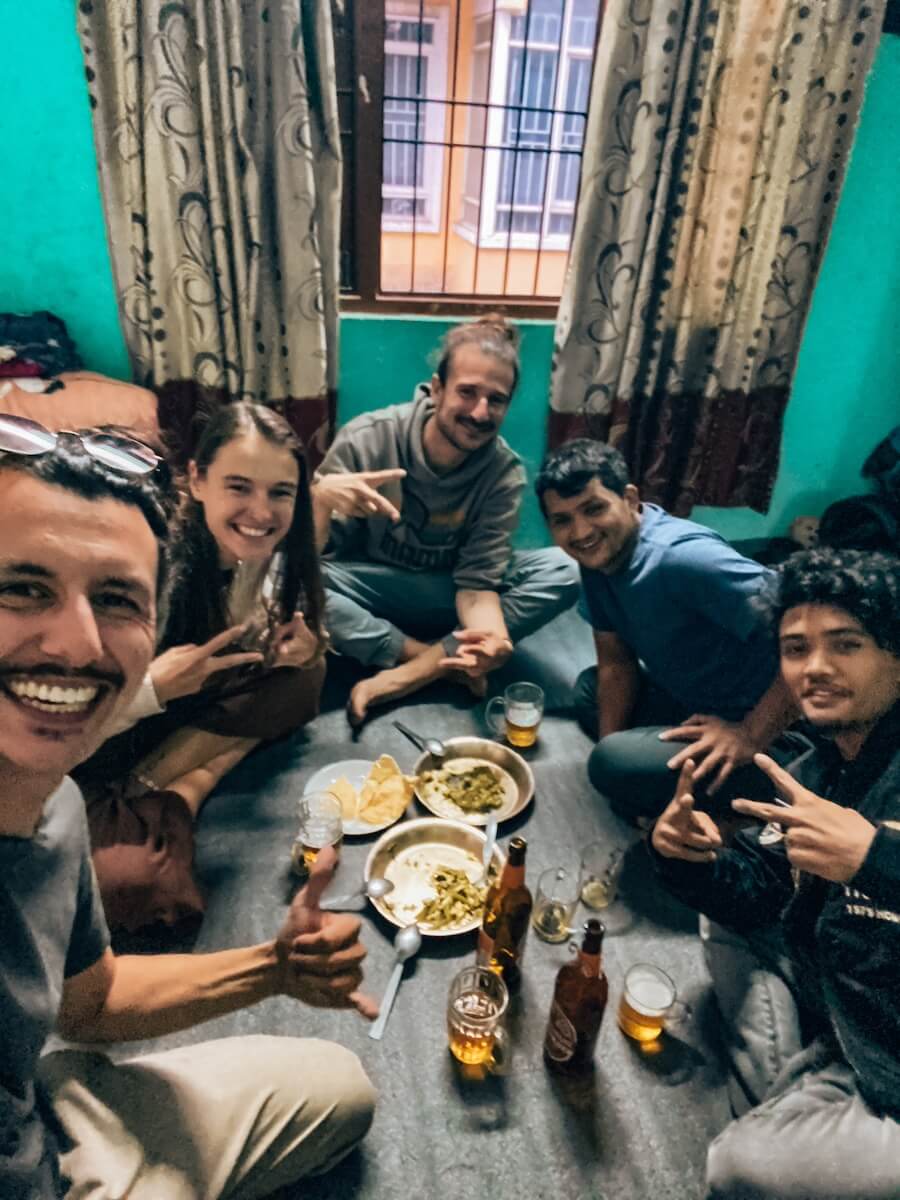
The family lives in a large house just outside. In the living room we sit together on the floor, we are served tea and we are allowed to taste delicious Nepalese specialties. Even before dinner, we are all more than full. To top it all off, there is, how could it be otherwise, Dal Bhat. Everything tastes really excellent and we almost burst.
After dinner we say goodbye. Arjun will be working in Austria again next summer and we have already agreed to visit him there in the Zillertal.
We spend the last few days in Kathmandu looking at and sorting out photos from the trek (thousands of photos we can tell you), writing down our travel diary and meeting Denis for coffee or dinner in between.
All in all, we really liked Nepal incredibly much and we are sure that we will come back here again. For now, however, we are ready for a change of country.